

Views: 222 Author: Zhang Xin Publish Time: 2026-11-17 Origin: Site


Content Menu
● Introduction: The Importance of Adhesives in Drone Manufacturing
● Why Are Adhesives Important in UAV Manufacturing?
>> Lightweight Design and Weight Reduction
>> Vibration Resistance and Mechanical Protection
>> Bonding Different Materials
>> Electrical Insulation and Environmental Protection
● Key Applications of Drone Adhesives
>> Structural Bonding for Drone Frames
>> Motor and Electronic Component Fixing
>> Battery Pack Bonding and Protection
>> PCB Encapsulation and Electronic Protection
>> Camera and Sensor Module Bonding
>> Waterproof Sealing and Housing Protection
>> Cable Fixing and Wire Harness Protection
● Types of Adhesives Used in Drone Manufacturing
● How to Select the Right Adhesive for UAV Applications
>> Mechanical and Vibration Requirements
>> Electrical Insulation Requirements
>> Manufacturing and Curing Process
● CYCT Adhesive Solutions for Drone and UAV Manufacturing
>> Silicone Adhesive Solutions
>> Customized Adhesive Development
● Future Trends in Drone Adhesive Technology
>> Lightweight and High-Strength Bonding
>> Advanced Electronic Protection
>> Improved Thermal Management
>> Automated Adhesive Dispensing
● Conclusion: Choosing the Right Drone Adhesive
● Frequently Asked Questions About Drone Adhesives
>> What types of adhesives are commonly used in drone manufacturing?
>> What is the best adhesive for bonding drone frames?
>> Can silicone adhesives be used in drone battery packs?
>> How can adhesives improve drone vibration resistance?
>> Are drone adhesives required to provide electrical insulation?
>> What should manufacturers consider when selecting adhesives for drone electronics?
>> Can CYCT provide customized adhesive solutions for UAV manufacturers?
>> How can manufacturers test drone adhesive reliability?
Unmanned Aerial Vehicles (UAVs), commonly known as drones, are becoming increasingly important in industries such as aerial photography, agriculture, logistics, infrastructure inspection, security, and industrial automation.
As drone technology continues to develop, manufacturers are focusing on lightweight structures, longer flight endurance, improved reliability, and more advanced electronic systems. These requirements make material selection and assembly technology increasingly important.
Adhesives play an essential role in modern UAV manufacturing. Compared with traditional mechanical fastening methods, adhesive bonding can reduce component weight, distribute mechanical stress, improve vibration resistance, and provide additional protection against moisture and environmental exposure.
From structural frame assembly to battery bonding, electronic encapsulation, and waterproof sealing, different adhesive technologies support various stages of drone production.
Silicone adhesives, epoxy adhesives, and polyurethane adhesives offer different properties to meet the bonding, insulation, sealing, and protection requirements of UAV components.
This article explores the major applications of drone adhesives, their technical advantages, and how manufacturers can select suitable adhesive solutions for reliable UAV production.
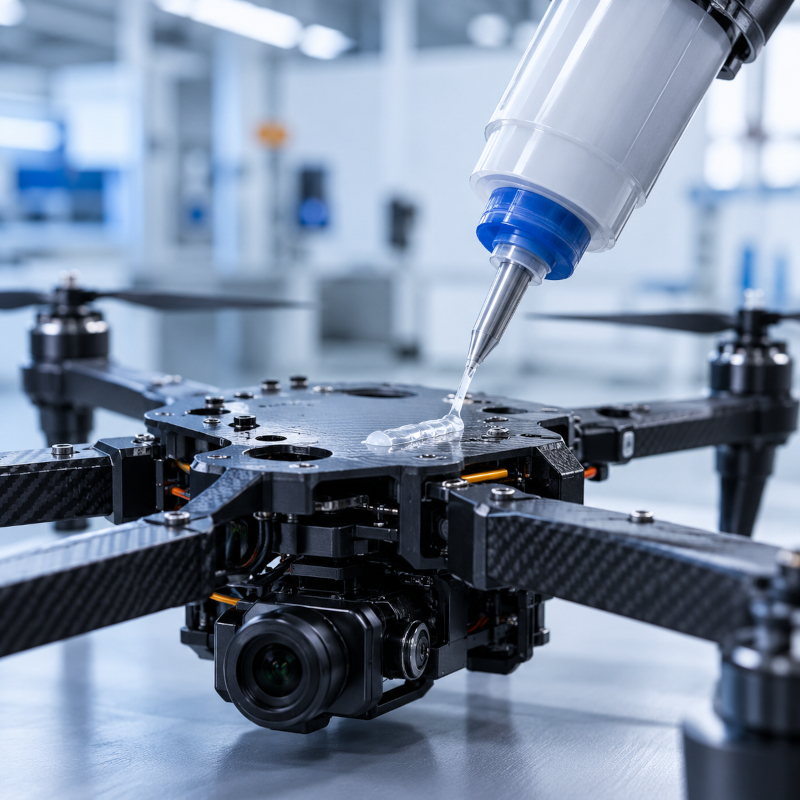
Weight is one of the most important considerations in drone design. Reducing aircraft weight can help improve flight endurance, payload capacity, and energy efficiency.
Adhesives can replace or complement certain mechanical fastening methods, reducing the need for additional screws, brackets, and connecting components.
They are particularly useful for bonding lightweight materials such as carbon fiber composites, aluminum alloys, and engineering plastics.
During flight, drones experience continuous vibration from motors, propellers, and other moving components.
These vibrations may affect electronic modules, sensors, cameras, connectors, and structural joints.
Flexible silicone and polyurethane adhesives can help absorb vibration, distribute stress, and reduce the risk of component movement or damage.
Drone structures often combine carbon fiber, aluminum, plastics, glass, and electronic materials.
These substrates have different surface properties and thermal expansion characteristics. Suitable adhesives can provide reliable bonding between dissimilar materials while accommodating different mechanical requirements.
Electronic systems are essential to drone operation. Flight controllers, batteries, sensors, and communication modules require protection against moisture, dust, contamination, and electrical interference.
Specialized adhesives and encapsulation materials can provide electrical insulation, moisture protection, and mechanical support for sensitive electronic components.
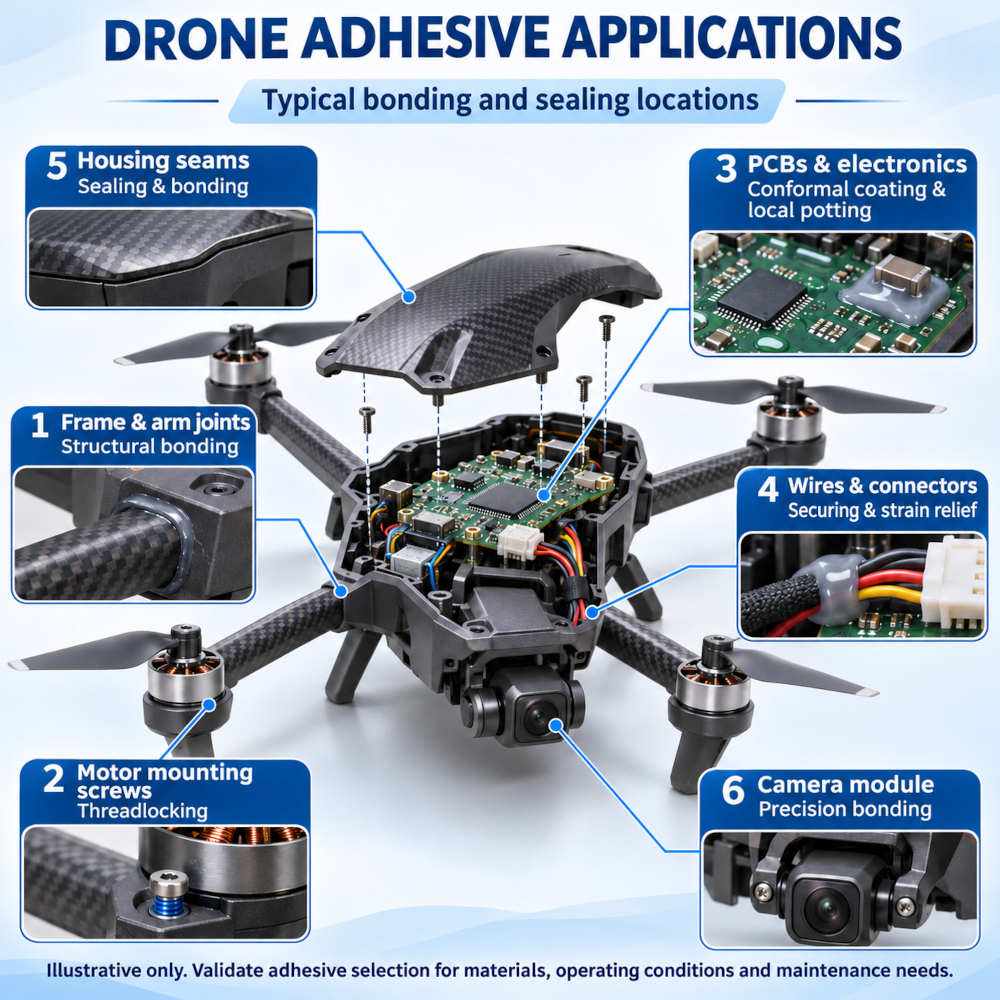
The drone frame provides structural support for the entire aircraft. It must withstand mechanical loads, vibration, landing impact, and environmental exposure.
Common structural materials include carbon fiber composites, aluminum alloys, and engineering plastics.
Epoxy structural adhesives are widely considered for applications requiring high bonding strength, mechanical stability, and dimensional accuracy.
Suitable adhesives can help bond different structural materials while reducing the need for additional mechanical fasteners.
Important properties include bonding strength, impact resistance, thermal stability, and compatibility with the substrates.
Drone motors generate continuous vibration and heat during operation. Electronic components must also remain securely positioned to maintain system reliability.
Adhesives can be used to fix selected components, reinforce assembly joints, and protect electronic modules.
Flexible adhesives are useful where vibration absorption and stress relief are required, while rigid adhesives may be suitable for applications requiring stronger mechanical fixation.
For safety-critical rotating components, adhesive bonding should only be used where validated by the mechanical design and testing process.
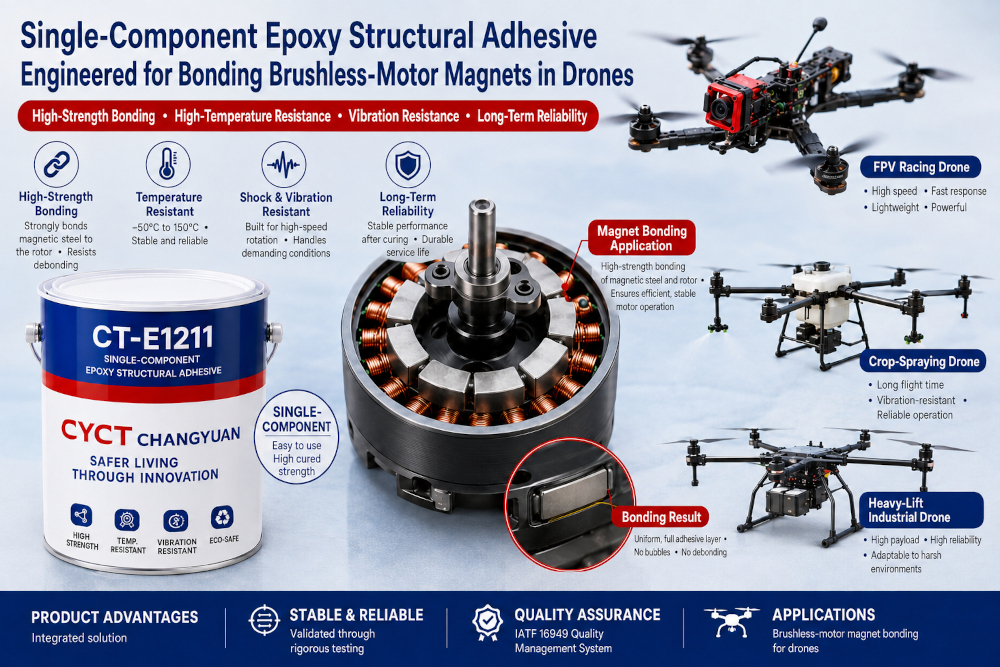
Battery systems directly affect drone flight time, payload capacity, and operational reliability.
Adhesives can support battery pack assembly through cell positioning, housing bonding, electrical insulation, sealing, and protection of selected electronic components.
Silicone adhesives are useful for applications requiring flexibility, temperature resistance, and electrical insulation.
Epoxy adhesives can be considered for rigid bonding and structural protection, while polyurethane materials may provide a balance between flexibility and mechanical durability.
Adhesive selection must consider thermal management, flame performance, chemical compatibility, dielectric properties, and battery safety requirements.
Printed Circuit Boards (PCBs) support flight controllers, navigation systems, communication modules, and power management electronics.
These components may be exposed to vibration, humidity, dust, and temperature changes.
Encapsulation materials help protect electronic assemblies against environmental contamination and mechanical stress.
Silicone encapsulation materials offer flexibility and thermal stability. Epoxy materials provide rigid protection and strong adhesion. Polyurethane materials offer a combination of flexibility and mechanical protection.
The appropriate material depends on curing conditions, viscosity, thermal expansion, electrical insulation, and rework requirements.
Modern drones integrate cameras, LiDAR systems, GPS modules, and other precision sensors.
These components require accurate positioning and stable bonding. Small movements or deformation can affect image quality, navigation accuracy, and measurement performance.
Adhesives for optical and sensor assemblies should provide dimensional stability, suitable bonding strength, low curing shrinkage, and resistance to vibration and temperature changes.
Specialized epoxy and silicone adhesives can be evaluated according to the structural and optical requirements.
Outdoor drones may encounter rain, humidity, dust, and changing temperatures.
Silicone sealants and other specialized sealing materials can be used for housing joints, cable entry points, connector interfaces, and electronic enclosures.
Suitable materials should provide good substrate adhesion, flexibility, moisture resistance, and long-term sealing performance.
The complete assembly should be validated through appropriate environmental and ingress protection testing.
Drone electrical systems contain numerous wires and connectors connecting batteries, motors, sensors, and control modules.
Adhesives can help secure selected wiring sections, seal cable entry points, and reduce unwanted movement.
Flexible silicone and polyurethane materials are useful where cable movement and vibration need to be accommodated.
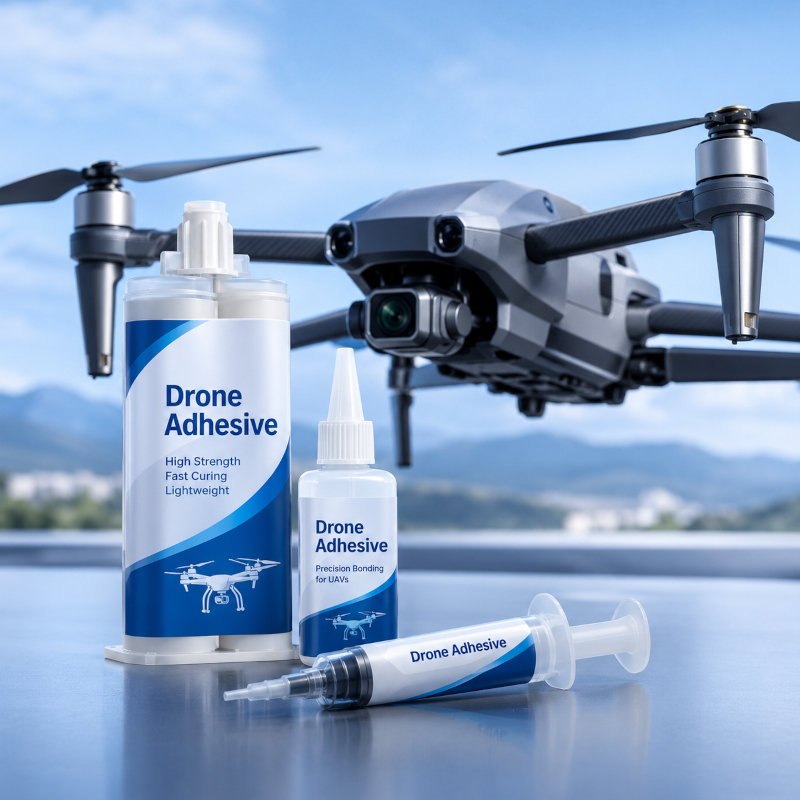
Silicone adhesives are widely used in electronic, electrical, and industrial applications because of their flexibility and thermal stability.
Their key characteristics include:
- Good flexibility and elasticity.
- Resistance to temperature fluctuations.
- Electrical insulation properties.
- Vibration absorption and stress relief.
- Weathering and moisture resistance in suitable formulations.
Potential UAV applications include electronic encapsulation, battery protection, housing sealing, cable fixation, and vibration-sensitive assemblies.
Different silicone formulations can be designed with different viscosities, hardness levels, curing mechanisms, and operating temperature ranges.
Epoxy adhesives are widely used for structural bonding, electronics manufacturing, and industrial assembly.
Their main advantages include:
- High mechanical strength.
- Strong adhesion to many engineering materials.
- Good dimensional stability.
- Electrical insulation properties.
- Chemical and thermal resistance in suitable formulations.
They are suitable for selected structural components, electronic modules, battery assemblies, and rigid encapsulation applications.
Different formulations can be developed for room-temperature curing, heat curing, flexible bonding, and specialized electrical insulation.
Polyurethane adhesives provide a combination of adhesion, flexibility, and mechanical durability.
Their characteristics may include:
- Good elasticity and flexibility.
- Impact and vibration resistance.
- Adhesion to different substrates.
- Stress distribution between bonded components.
- Suitable sealing performance.
They can be considered for selected housing assemblies, composite bonding, cable fixation, and applications requiring flexible connections.
Selecting an adhesive requires evaluating the complete application rather than simply choosing the material with the highest bonding strength.
Identify the materials being bonded, such as carbon fiber, aluminum, ABS, PC, glass, or electronic substrates.
Surface cleanliness, roughness, surface energy, and coating compatibility can significantly affect bonding performance.
Drone components experience different temperatures depending on their location and operating conditions.
Manufacturers should evaluate continuous operating temperature, short-term temperature tolerance, thermal cycling performance, and curing conditions.
Structural joints may require high mechanical strength, while electronic modules and cable assemblies may benefit from flexible materials.
Adhesive selection should consider load type, joint geometry, bond-line thickness, and expected movement.
Adhesives used around batteries, motors, PCBs, and electronic control systems may require specific dielectric properties.
Important parameters include dielectric strength, volume resistivity, and surface resistivity.
Production factors include viscosity, mixing ratio, pot life, dispensing requirements, curing temperature, curing time, and storage conditions.
For mass production, stable dispensing characteristics and consistent curing performance can improve manufacturing efficiency.
Depending on the application, manufacturers should evaluate moisture resistance, thermal cycling, vibration, mechanical shock, UV exposure, chemical compatibility, and long-term adhesion retention.
Testing should reflect actual operating conditions and product specifications.
CYCT specializes in the research, development, and manufacturing of adhesive materials, including silicone-based and epoxy-based systems, serving new energy, electronics, electrical, and industrial applications.
For UAV manufacturers, adhesive selection should be based on component structure, substrate materials, operating temperature, mechanical requirements, and manufacturing processes.
CYCT silicone adhesive technologies can support applications requiring flexibility, electrical insulation, thermal resistance, and environmental protection.
Potential applications include:
- Electronic component encapsulation.
- Battery pack insulation and protection.
- Cable and connector sealing.
- Vibration-sensitive component fixation.
- Electronic housing sealing.
- Selected motor and power system assemblies.
CYCT epoxy adhesive technologies can be considered for applications requiring reliable adhesion, mechanical strength, electrical insulation, and dimensional stability.
Potential applications include:
- Structural component bonding.
- Electronic module fixation.
- PCB encapsulation.
- Battery assembly bonding.
- Electrical insulation.
- Selected composite and metal bonding.
Different UAV manufacturers have different product structures, production processes, and performance requirements.
CYCT can work with customers to evaluate suitable adhesive technologies based on substrate combinations, bonding strength, operating temperature, flexibility, hardness, electrical insulation, curing conditions, and dispensing requirements.
Application evaluation and customized material development can help manufacturers improve assembly reliability and production efficiency.
Future drone designs will continue to focus on reducing weight while maintaining structural strength. Advanced adhesives will support the assembly of carbon fiber composites, lightweight metals, and engineering plastics.
The integration of artificial intelligence, autonomous navigation, and advanced sensors will increase the complexity of drone electronic systems.
More specialized encapsulation and insulation materials will be needed to protect sensitive electronics.
As batteries, motors, and electronic systems become more powerful, thermal management will become increasingly important.
Adhesive development will focus on suitable thermal conductivity, electrical insulation, and long-term thermal stability.
Automated dispensing and controlled curing processes can improve application accuracy, reduce material waste, and enhance production consistency.
Adhesives with stable viscosity and suitable working times will become increasingly important for automated UAV manufacturing.
Adhesives are becoming increasingly important in modern UAV manufacturing. From structural bonding and battery assembly to electronic encapsulation, waterproof sealing, and vibration protection, adhesive materials contribute to drone reliability and performance.
Silicone, epoxy, and polyurethane adhesives each offer different advantages for specific applications.
The right material depends on substrate compatibility, mechanical requirements, operating temperature, electrical insulation, environmental exposure, and manufacturing conditions.
CYCT provides silicone and epoxy adhesive technologies for industrial bonding, insulation, encapsulation, and protection applications. By evaluating specific customer requirements, CYCT aims to support UAV manufacturers in identifying suitable adhesive solutions.
Contact CYCT to discuss your drone adhesive requirements and explore suitable bonding, insulation, encapsulation, and sealing solutions.
Silicone, epoxy, and polyurethane adhesives are commonly considered. Silicone is suitable for flexible sealing and insulation, epoxy for structural bonding and rigid encapsulation, and polyurethane for flexible bonding and mechanical protection.
Epoxy structural adhesives are often considered for carbon fiber, aluminum, and engineering plastic structures. The final selection depends on substrate compatibility, joint design, and mechanical requirements.
Yes. Suitable silicone adhesives can be used for insulation, component fixation, sealing, and electronic protection. Thermal management and battery safety requirements must also be considered.
Flexible adhesives can absorb vibration, distribute mechanical stress, and reduce movement between bonded components. Performance depends on material properties and joint design.
Not all adhesives require electrical insulation. However, materials used around batteries, PCBs, motors, and electronic modules may need specific dielectric properties.
Important factors include viscosity, curing conditions, electrical insulation, thermal stability, moisture resistance, substrate compatibility, and long-term reliability.
CYCT can evaluate silicone and epoxy adhesive technologies according to customer requirements, including substrate materials, operating temperatures, bonding strength, flexibility, insulation, and production processes.
Common evaluation methods include lap shear testing, tensile testing, peel testing, thermal cycling, humidity aging, vibration testing, and electrical insulation testing.


