

Views: 222 Author: Zhang Xin Publish Time: 2026-09-24 Origin: Site


Content Menu
● The Role of Magnet Bonding in Electric Motors
● Magnet Bonding for Drone Motors
>> Why Drone Motors Need Reliable Magnet Fixation
>> Key Requirements for Drone Motor Adhesives
>>> Manufacturing Compatibility
● Magnet Bonding for Humanoid Robot Joint Motors
>> Dynamic Loads in Robot Joint Motors
>> Requirements for Humanoid Robot Motor Adhesives
● Why Use Structural Adhesives for Magnet Bonding?
>> Accurate Magnet Positioning
● How to Select a Magnet Bonding Adhesive
>> Magnet Material and Surface
● CYCT CT-E1211 One-Component Epoxy Structural Adhesive
>>> Medium-Temperature Heat Curing
>>> Adhesion to Magnets and Metals
>>> Wide Stated Service Temperature Range
● CT-E1211 Technical Performance
● CT-E1211 Motor Magnet Bonding Process
>> 5. Heat Cure
● CT-E1211 for Drone Motor Applications
● CT-E1211 for Humanoid Robot Joint Motors
● Validation Before Mass Production
● Why Work with a Specialized Adhesive Supplier?
>> What type of adhesive is suitable for permanent magnet bonding?
>> Is CT-E1211 suitable for motor magnet bonding?
>> What is the curing condition of CT-E1211?
>> What is the operating temperature range of CT-E1211?
>> Can CT-E1211 be used for drone motors?
>> Can CT-E1211 be used for humanoid robot joint motors?
>> What are the main advantages of CT-E1211?
>> What materials can CT-E1211 bond?
>> What should be tested before mass production?
As drones and humanoid robots become lighter, faster, and more capable, their electric motors must deliver higher power density while maintaining compact dimensions and reliable operation. This places greater demands on the materials used inside the motor, particularly those responsible for securing permanent magnets.
Permanent magnets are essential to the operation of many brushless and permanent magnet motors. Their position affects magnetic performance, rotor balance, torque output, and overall motor stability. During operation, the magnets can be exposed to centrifugal forces, vibration, temperature changes, and repeated mechanical loads.
Adhesive bonding provides an efficient way to secure magnets to metal motor components. A suitable structural adhesive can create a strong interface while supporting compact designs and streamlined assembly processes.
For drone motors, the primary challenges include high rotational speed, vibration, and weight constraints. Humanoid robot joint motors face a different combination of demands, including repeated acceleration and deceleration, changing torque, vibration, and thermal cycling.
This article examines the key requirements for motor magnet bonding and introduces CYCT CT-E1211 one-component epoxy structural adhesive as a potential solution for applications involving permanent magnets and metal substrates.
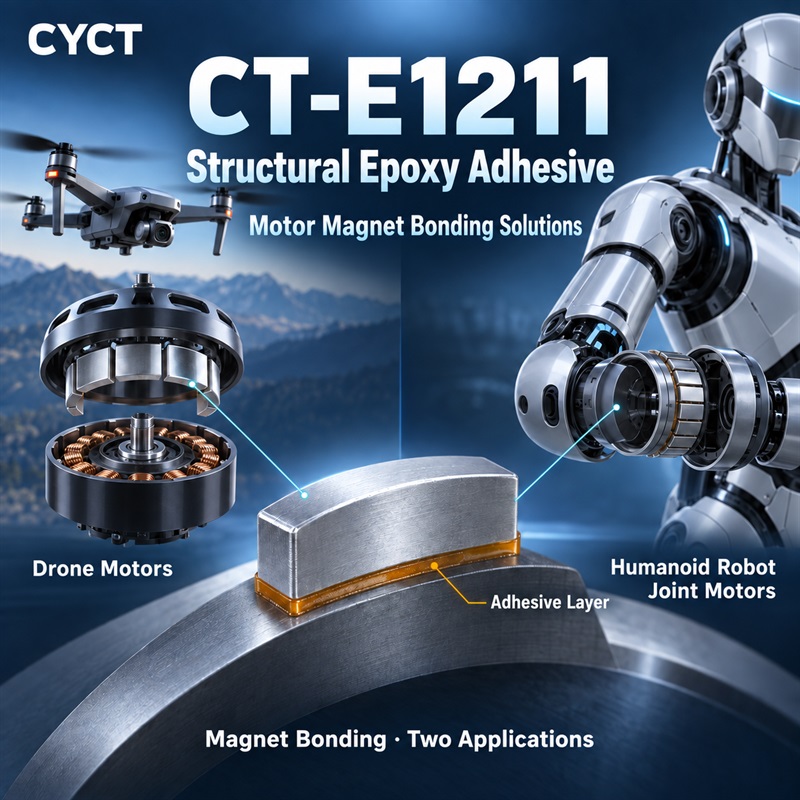
Permanent magnets need to remain accurately positioned throughout the motor's service life. Magnet movement can affect the magnetic field, rotor balance, and mechanical performance.
For this reason, adhesive selection should consider more than initial bond strength. Key factors include:
* Adhesion to permanent magnets
* Adhesion to metal substrates
* Mechanical strength
* Temperature resistance
* Vibration resistance
* Dimensional stability
* Curing conditions
* Manufacturing efficiency
* Long-term durability
As motors become smaller and operate at higher speeds, the bonding system becomes an increasingly important part of the overall motor design.
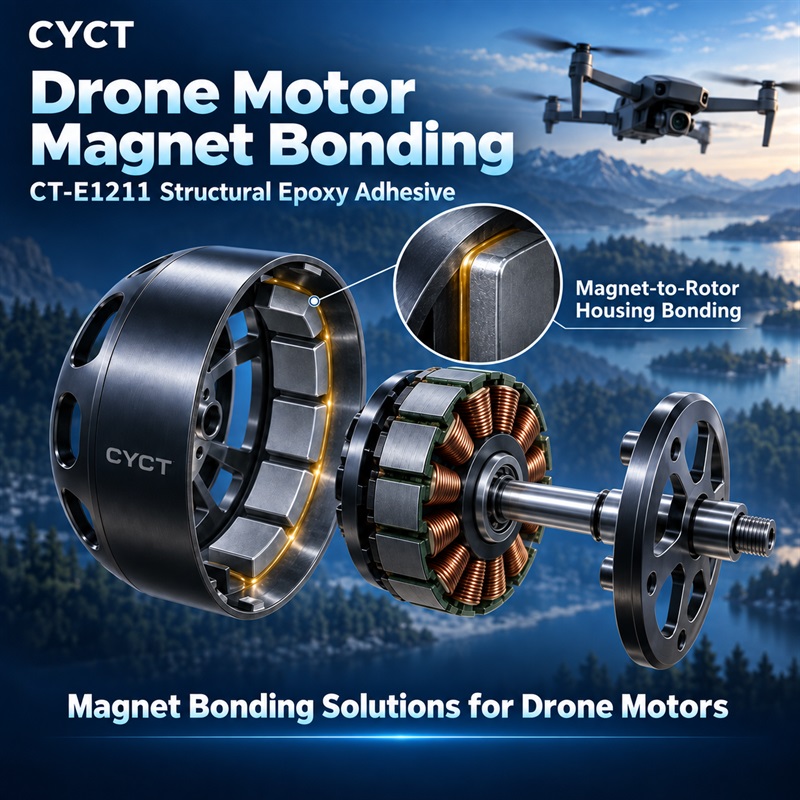
Drone propulsion systems typically require motors that combine high rotational speed and torque with low weight. Permanent magnets are commonly incorporated into the rotor and must remain securely positioned during operation.
High-speed rotation generates centrifugal forces, while propeller imbalance, acceleration, deceleration, and flight conditions can introduce vibration and mechanical stress.
A suitable drone motor adhesive therefore needs to maintain adequate mechanical properties under the actual operating conditions of the motor.
Several characteristics are particularly relevant:
The adhesive must provide sufficient retention to withstand forces generated by the rotating assembly.
Motor temperatures can rise during continuous or high-load operation. The adhesive should maintain suitable properties across the expected temperature range.
Continuous vibration can place repeated stress on the magnet-substrate interface. The bonding system should be evaluated under representative vibration conditions.
For volume production, the adhesive must fit the dispensing, positioning, fixturing, and curing process. Working time and curing speed can directly affect production efficiency.
Humanoid robots rely on multiple compact actuators to control joints such as the shoulders, elbows, wrists, hips, knees, and ankles.
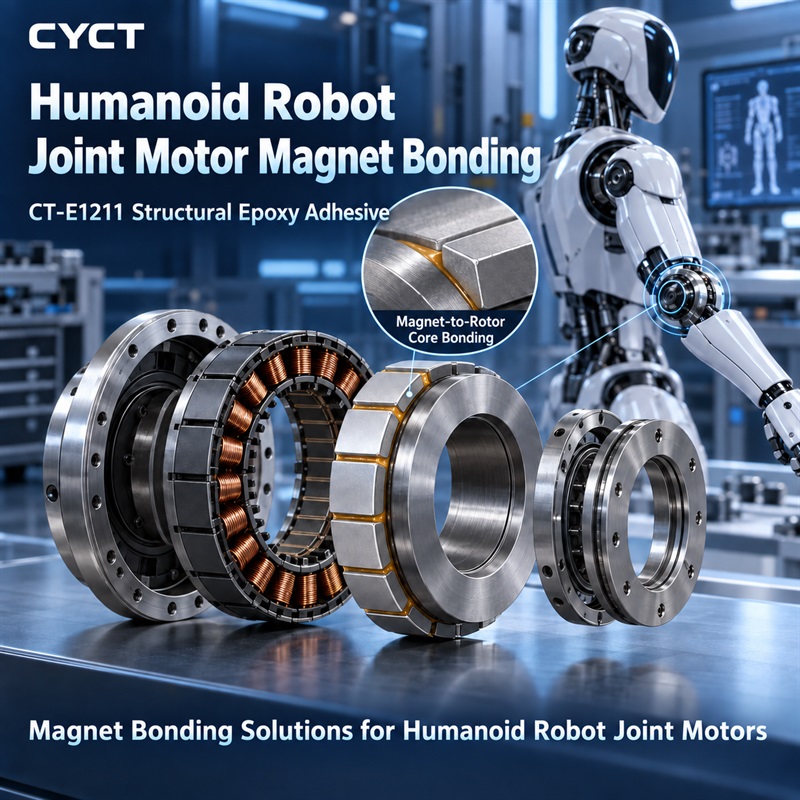
Robot joint motors frequently accelerate, decelerate, reverse direction, and operate under changing loads. A knee or hip actuator, for example, may experience repeated torque changes during walking, while an arm actuator may continuously adjust its output during object manipulation.
These operating conditions make mechanical stability inside the motor particularly important.
A humanoid robot motor adhesive should be assessed in relation to:
* Bond strength
* Temperature resistance
* Vibration
* Mechanical fatigue
* Magnet and substrate compatibility
* Curing efficiency
* Dimensional stability
* Expected service life
Compact actuator designs also place greater emphasis on efficient assembly and accurate component positioning.
Structural adhesives create a bonded interface between the permanent magnet and its supporting component. Depending on the motor design, this can provide several advantages over relying exclusively on mechanical retention.
A bonded interface can distribute load across the contact area rather than concentrating forces at a limited number of mechanical fixation points.
Adhesive bonding may reduce the need for additional retention components, helping engineers optimize space and weight.
Dispensing and magnet placement can be integrated into automated manufacturing processes.
Adhesive bonding can help maintain the designed magnet location during assembly and after curing.
These benefits do not eliminate the need for mechanical safety considerations. High-speed rotor designs should always be evaluated according to their specific mechanical requirements.
Selecting a permanent magnet bonding adhesive requires consideration of the complete bonding system.
NdFeB and other permanent magnets may have protective coatings or surface treatments. Adhesive compatibility should therefore be evaluated using the actual finished magnet rather than the underlying magnet material alone.
Motor components may use steel, galvanized steel, stainless steel, or other metals. Surface condition and material composition can affect adhesion.
Oil, grease, dust, oxidation, and manufacturing residues can interfere with bonding. Appropriate cleaning and surface preparation are important for consistent results.
The adhesive should be matched to the motor's actual temperature profile, including normal operation, peak temperature, and thermal cycling.
Curing conditions need to fit the manufacturing line. Temperature, curing time, equipment, and thermal mass can all influence the final process.
For motor magnet bonding, CYCT CT-E1211 is a one-component, heat-curing epoxy structural adhesive designed for applications requiring strong adhesion and controlled thermal curing.
According to the CT-E1211 technical data sheet, the product provides high bonding strength, electrical insulation, chemical resistance, and low shrinkage after curing. It is solvent-free and is stated to meet RoHS and REACH requirements.
The product is particularly intended for bonding magnets, galvanized steel, and stainless steel, making it relevant to permanent magnet motor assembly.
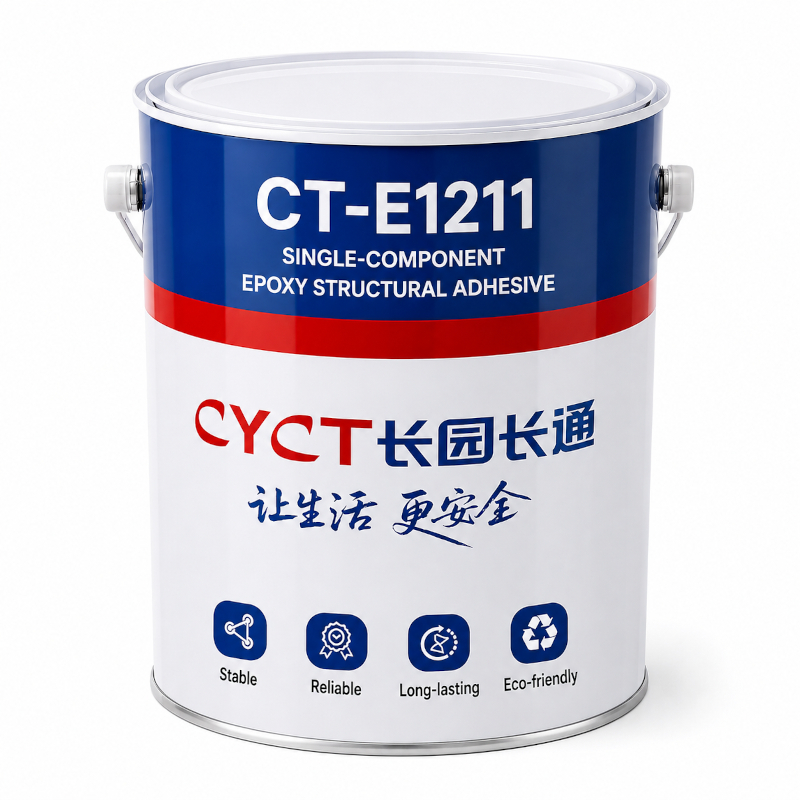
CT-E1211 is supplied as a one-component epoxy adhesive, eliminating the need to mix separate resin and curing components immediately before application.
This can simplify dispensing and support process consistency.
The technical data sheet specifies a curing condition of 85°C for 45 minutes.
This makes the product relevant to manufacturing processes where controlled thermal curing is available.
CT-E1211 is specifically described as providing high bonding strength to metals, particularly magnets, galvanized steel, and stainless steel, under normal and elevated temperatures.
The specified operating temperature range is -50°C to 150°C.
This provides a useful reference when considering motors exposed to significant temperature variation.
The product information indicates that CT-E1211 does not require low-temperature storage, although the technical data sheet also specifies refrigerated storage and a stated shelf life of 3–6 months. Manufacturers should follow the supplier's current storage instructions for production materials.
Before curing, CT-E1211 is described as a black viscous liquid with a viscosity of 70,000 ± 20,000 mPa·s at 25°C. Its operating time at 40°C is greater than 48 hours, while the specified gel time at 80°C is 11 minutes.
After curing, the technical data sheet specifies:
* Density: 1.45 ± 0.1 g/cm³
* Shore D hardness: ≥80
* Glass transition temperature: ≥110°C
* Tensile strength: ≥30 MPa
* Elongation at break: ≥4%
* Electrical strength: ≥20 kV/mm
For galvanized steel-to-galvanized steel bonding, the specified shear strength is ≥21 MPa at 23°C and ≥5 MPa at 120°C.
These figures are useful reference data for material evaluation. Motor manufacturers should additionally test the actual magnet, coating, substrate, adhesive thickness, and curing process used in production.
A typical bonding process can be organized into six stages.
Inspect the magnet and motor component for dimensional accuracy, coating condition, and surface contamination.
The bonding surfaces should be appropriately cleaned before adhesive application.
Apply CT-E1211 to the designated bonding area.
Its relatively high viscosity should be considered when selecting dispensing equipment and defining the required adhesive volume.
Place the permanent magnet accurately according to the motor design. Precise positioning is important for magnetic performance and rotor balance.
Use appropriate fixtures where necessary to maintain magnet position and bond-line geometry during curing.
CT-E1211 has a specified curing condition of 85°C for 45 minutes.
The actual production cycle should be established according to the assembly, equipment, and thermal characteristics of the motor components.
After curing, inspect magnet position, adhesive coverage, dimensional accuracy, and overall bond integrity.
CT-E1211 is a candidate for drone motor magnet bonding because its technical data sheet specifically identifies magnets and metal substrates as applicable bonding materials.
Its one-component format, heat-curing process, and stated -50°C to 150°C service temperature range may also be relevant to motor manufacturing requirements.
For high-speed drone rotors, manufacturers should evaluate magnet retention under the actual rotational speed, temperature, vibration, and mechanical loading conditions of the finished motor.
CT-E1211 can also be evaluated for humanoid robot joint motors where permanent magnets are bonded to compatible metal substrates.
Its specified suitability for magnets, galvanized steel, and stainless steel makes it relevant to motor structures using these materials.
For robotic actuators, the evaluation should focus on the joint's torque cycles, vibration, temperature variation, rotational conditions, and expected operating life.
A robust validation program should reflect the actual motor design rather than relying only on generic adhesive data.
Test the actual magnet and substrate combination using the intended adhesive thickness and curing cycle.
Evaluate the bonded assembly at normal and elevated operating temperatures.
Repeated heating and cooling can reveal changes in the bonded interface that may not appear in room-temperature testing.
Test the complete motor assembly under representative vibration conditions.
For rotor applications, controlled high-speed testing can help evaluate magnet retention under centrifugal loading. Appropriate safety procedures are essential.
Long-term aging can provide additional information about performance over the expected service period.
Motor magnet bonding involves more than adhesive strength alone. The final result depends on the interaction between the magnet, coating, substrate, surface preparation, adhesive thickness, dispensing method, curing process, and operating environment.
A specialized adhesive supplier can help manufacturers assess these variables during product development and production qualification.
For new drone motors and robotic actuators, early evaluation can also help optimize the bonding process before mass production.
Permanent magnet fixation is a critical consideration in compact, high-performance electric motors. Drone motors must withstand high-speed rotation and vibration, while humanoid robot joint motors face repeated changes in torque, direction, and mechanical load.
A suitable magnet bonding adhesive can provide structural fixation while supporting compact motor construction and efficient manufacturing.
CYCT CT-E1211 is a one-component, heat-curing epoxy structural adhesive specifically described for bonding magnets, galvanized steel, and stainless steel. Its technical data sheet reports high bonding strength, electrical insulation, chemical resistance, low shrinkage, and a stated service temperature range of -50°C to 150°C.
With a specified curing condition of 85°C for 45 minutes, CT-E1211 can be considered for motor manufacturing processes that support controlled thermal curing.
For drone motors and humanoid robot joint motors, the final adhesive choice should be confirmed using the actual magnet, substrate, coating, bond-line design, curing process, and operating conditions. A controlled bonding process combined with application-specific validation can help manufacturers develop consistent and durable motor assemblies.
Structural epoxy adhesives are one option for applications requiring strong adhesion between permanent magnets and metal components. Selection should consider the magnet, substrate, temperature, vibration, rotational speed, curing process, and expected service life.
CT-E1211 is specifically described as suitable for bonding magnets, galvanized steel, and stainless steel. It is a one-component heat-curing epoxy structural adhesive and can therefore be considered for permanent magnet bonding applications, subject to validation with the actual motor design.
The specified curing condition is 85°C for 45 minutes.
The stated service temperature range is -50°C to 150°C.
CT-E1211 can be evaluated for drone motor magnet bonding because the product is specifically described for bonding magnets and metal substrates. Final suitability should be established under the actual motor's speed, temperature, vibration, and load conditions.
It can be considered where the motor uses compatible magnet and metal substrates. Evaluation should account for torque cycles, vibration, temperature changes, rotational conditions, and service-life requirements.
CT-E1211 combines a one-component formulation with heat curing, high bonding strength, electrical insulation, chemical resistance, low shrinkage, and a stated -50°C to 150°C service temperature range.
The product is particularly specified for magnets, galvanized steel, and stainless steel.
Manufacturers should evaluate the actual magnet and substrate combination for bond strength, thermal performance, thermal cycling, vibration, curing consistency, dimensional stability, and rotational performance where relevant.


