

Views: 222 Author: Site Editor Publish Time: 2026-07-06 Origin: Site


Content Menu
● What Is PET Heat Shrink Tubing?
● Why Supercapacitors Require Protective Heat Shrink Tubing
● Why PET Is the Preferred Material for Supercapacitor Sleeves
>> Excellent Electrical Insulation
>> Excellent Dimensional Stability
>> Outstanding Chemical Resistance
>> Environmentally Friendly Material
● Major Applications of PET Heat Shrink Tubing in Supercapacitors
● Key Properties of PET Heat Shrink Tubing for Supercapacitors
>> Excellent Electrical Insulation
>> Outstanding Mechanical Protection
>> Excellent Chemical Resistance
>> Excellent Printing Performance
● How to Select PET Heat Shrink Tubing for Supercapacitors
>> Determine the Correct Diameter
>> Select the Appropriate Wall Thickness
>> Evaluate Heat Shrink Temperature
>> Verify Electrical Performance
>> Assess Mechanical Requirements
>> Consider Printing Requirements
>> Choose the Appropriate Color
>> Confirm Environmental Compliance
● PET vs. PVC vs. Polyolefin Heat Shrink Tubing
>> H3: Polyolefin Heat Shrink Tubing
● Common Mistakes to Avoid When Selecting PET Heat Shrink Tubing
>> Choosing Tubing Based Only on Price
>> Ignoring Manufacturing Compatibility
>> Overlooking Future Environmental Requirements
>> Failing to Verify Printing Quality
>> Neglecting Long-Term Reliability
● Future Trends of PET Heat Shrink Tubing for Supercapacitors
● Frequently Asked Questions (FAQs)
>> 1. Why is PET heat shrink tubing commonly used for supercapacitors?
>> 2. How do I choose the correct PET heat shrink tubing size?
>> 3. Is PET heat shrink tubing better than PVC for supercapacitors?
>> 4. Can PET heat shrink tubing be custom printed?
>> 5. What industries use PET heat shrink tubing for supercapacitors?
>> 6. Does PET heat shrink tubing support automated production?
>> 7. Is PET heat shrink tubing environmentally friendly?
>> 8. What should I look for when selecting a PET heat shrink tubing supplier?
As global demand for clean energy, electric transportation, industrial automation, and intelligent power management continues to grow, supercapacitors have become an increasingly important component in modern electronic systems. Known for their exceptional power density, rapid charge and discharge capability, and long cycle life, supercapacitors are widely used in renewable energy storage, electric vehicles, backup power systems, smart meters, rail transportation, and industrial equipment.
Although the internal design and electrochemical performance of a supercapacitor determine its electrical characteristics, external protection is equally essential. One often-overlooked yet critical component is the PET heat shrink tubing that surrounds the capacitor body. This protective sleeve provides electrical insulation, mechanical strength, environmental resistance, product identification, and an attractive appearance.
Selecting the appropriate PET heat shrink tubing is not simply a matter of choosing the correct size. Manufacturers must also evaluate shrink ratio, wall thickness, dielectric strength, temperature resistance, printing capability, dimensional stability, and environmental compliance. A carefully selected heat shrink sleeve can improve manufacturing efficiency, increase product reliability, and extend the service life of the finished supercapacitor.
This guide explores everything manufacturers need to know when selecting PET heat shrink tubing for supercapacitors, including material characteristics, selection criteria, performance advantages, manufacturing considerations, and future industry trends.
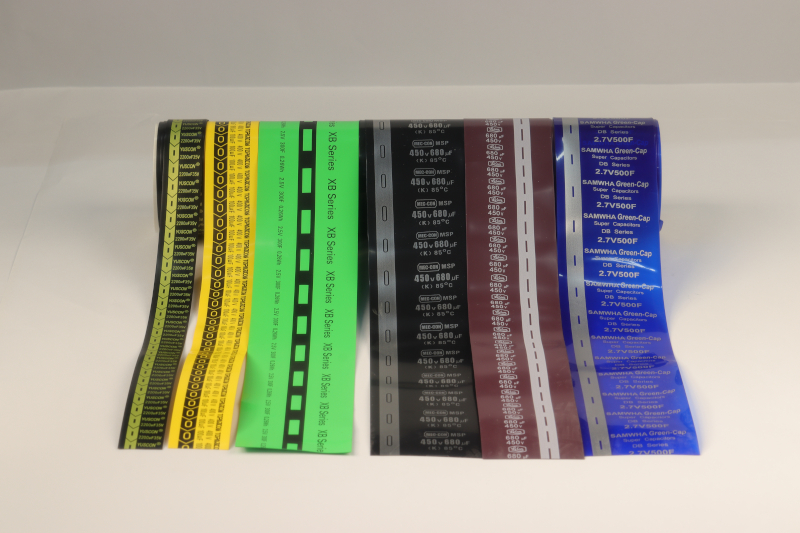
PET heat shrink tubing is a polymer-based insulating sleeve manufactured from polyethylene terephthalate. Through extrusion, biaxial orientation, controlled expansion, and heat-setting processes, the tubing acquires the ability to shrink uniformly when heated to a specified temperature.
During assembly, the tubing is placed over the cylindrical body of a supercapacitor. When exposed to hot air or infrared heating, the material shrinks tightly around the component, creating a smooth, durable, and secure protective covering.
Unlike adhesive tapes or conventional plastic films, PET heat shrink tubing forms a seamless outer layer that conforms precisely to the capacitor surface. This provides both functional protection and a professional appearance while simplifying automated production.
Because PET offers an excellent balance of mechanical strength, electrical insulation, heat resistance, and environmental performance, it has become one of the preferred materials for insulating cylindrical electronic components.
Supercapacitors often operate under demanding electrical and environmental conditions. During repeated charging and discharging, they may experience elevated temperatures, mechanical vibration, humidity, and continuous electrical stress. Without proper insulation, these factors can negatively affect reliability and safety.
PET heat shrink tubing serves multiple protective functions that contribute to long-term performance.
The metal housing of a supercapacitor can become electrically conductive during operation. PET heat shrink tubing creates an insulating barrier between the capacitor body and surrounding conductive components, significantly reducing the risk of accidental short circuits.
High dielectric strength also allows the tubing to maintain insulation performance under elevated operating voltages.
Throughout manufacturing, transportation, and installation, supercapacitors may encounter scratches, abrasion, vibration, and minor impacts.
PET heat shrink tubing absorbs external stress and protects the metal casing from cosmetic and functional damage. This additional protection helps preserve product quality throughout the supply chain.
Industrial applications frequently expose supercapacitors to dust, moisture, oils, cleaning agents, and various chemicals.
A tightly fitted PET sleeve minimizes direct exposure of the capacitor surface to these contaminants, improving durability in challenging environments.
Modern PET heat shrink tubing supports high-quality gravure printing and custom markings.
Manufacturers can print:
* Company logos
* Product models
* Voltage ratings
* Capacitance values
* Manufacturing dates
* QR codes
* Traceability information
* Safety warnings
Clear identification improves inventory management and production traceability while enhancing brand recognition.
A professionally shrunk PET sleeve provides a clean, wrinkle-free finish that enhances the overall appearance of the final product.
Available in a wide range of colors and printable finishes, PET heat shrink tubing helps manufacturers create visually consistent products that align with their branding requirements.
Several heat shrink materials are available on the market, including PVC, polyolefin, polyester blends, and PET. Among these options, PET has become increasingly popular for high-performance supercapacitors because it offers an excellent balance of physical, electrical, and environmental properties.
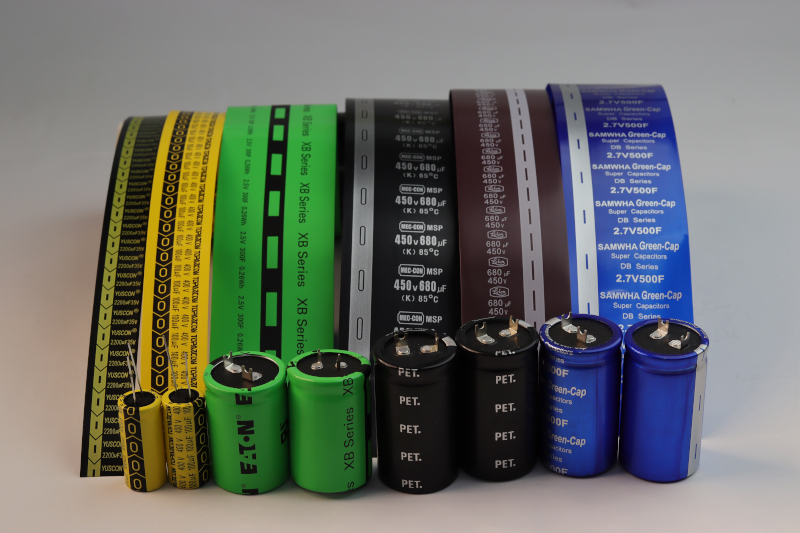
PET possesses outstanding dielectric properties, making it highly suitable for electrical insulation applications.
Its high dielectric strength reduces leakage current and improves operational safety in demanding electrical environments.
For energy storage devices operating at higher voltages, this characteristic is particularly valuable.
Compared with many traditional shrink materials, PET exhibits superior tensile strength and puncture resistance.
These properties enable the tubing to withstand handling during automated production without tearing or deformation.
The finished sleeve also maintains its shape over long periods of use.
Supercapacitors may generate heat during rapid charge and discharge cycles.
PET maintains dimensional stability across a broad operating temperature range and resists deformation under elevated temperatures encountered during manufacturing and normal operation.
This stability contributes to consistent insulation performance throughout the product's lifetime.
Uniform shrinkage is essential for achieving a smooth, wrinkle-free finish.
High-quality PET heat shrink tubing shrinks evenly around the capacitor body, reducing defects such as bubbles, folds, or uneven coverage.
Consistent shrink performance also improves production efficiency in automated manufacturing lines.
PET demonstrates good resistance to many industrial chemicals, lubricants, cleaning agents, and environmental contaminants.
This characteristic helps preserve the appearance and protective performance of the sleeve in industrial environments where exposure to chemicals may occur.
As sustainability becomes increasingly important across the electronics industry, PET offers significant environmental advantages.
Many PET heat shrink tubing products are manufactured without heavy metals and can comply with international environmental regulations such as RoHS and REACH. Additionally, PET is recyclable under appropriate recycling systems, making it a more environmentally responsible choice than some traditional insulation materials.
PET heat shrink tubing is widely used across numerous supercapacitor designs and industries.
Typical applications include:
* Electric vehicles
* Hybrid vehicles
* Energy storage systems
* Solar power equipment
* Wind energy systems
* Industrial automation
* Smart grid equipment
* UPS backup power systems
* Medical electronic devices
* Rail transit systems
* Consumer electronics
* Telecommunications infrastructure
As supercapacitors continue to replace or complement conventional batteries in high-power applications, the demand for reliable insulating materials continues to increase.
The quality of the outer protective sleeve plays an important role in ensuring product safety, durability, and manufacturing consistency.
Selecting the right PET heat shrink tubing begins with understanding its key performance characteristics. While different manufacturers may offer products with varying specifications, high-quality PET heat shrink tubing generally shares several important properties that make it suitable for supercapacitor applications.
These properties not only influence product reliability but also affect manufacturing efficiency, product appearance, and long-term operating performance.
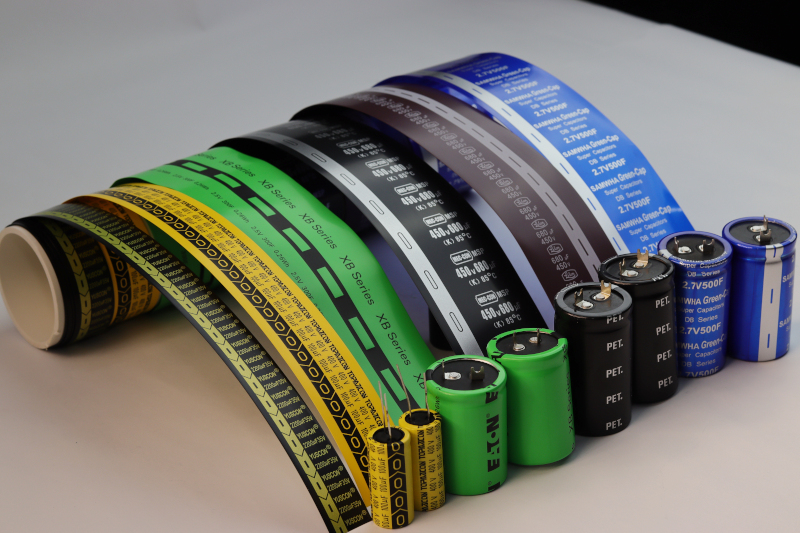
Electrical insulation is one of the primary reasons PET heat shrink tubing is used in supercapacitor manufacturing.
Since the outer shell of many cylindrical supercapacitors is made of metal, direct contact with nearby conductive components could result in electrical shorts or system failures. PET tubing forms a durable insulating barrier that helps isolate the capacitor body from surrounding parts.
Its high dielectric strength enables the sleeve to withstand electrical stress without breakdown under normal operating conditions. Even in high-voltage energy storage systems, properly selected PET tubing provides reliable insulation that supports safe and stable operation.
For manufacturers, consistent insulation performance also reduces the risk of quality defects during final product testing.
Supercapacitors are exposed to various forms of mechanical stress throughout their life cycle.
During production, they move through automated assembly equipment, printing stations, shrink ovens, packaging lines, and transportation systems. Each step introduces opportunities for scratches, abrasion, vibration, or minor impacts.
PET heat shrink tubing acts as a protective outer layer that helps preserve the integrity of the metal can. Its high tensile strength and puncture resistance allow it to withstand handling without tearing or cracking.
A properly shrunk sleeve also reduces cosmetic damage, helping manufacturers deliver products with a clean and professional appearance.
For applications involving vibration, such as electric vehicles or industrial equipment, this additional layer of protection contributes to improved durability.
Temperature stability is another important factor when selecting PET heat shrink tubing.
Supercapacitors often experience temperature fluctuations during rapid charging and discharging. In addition, the heat shrink process itself requires exposure to elevated temperatures.
High-quality PET tubing maintains excellent dimensional stability during shrinking while continuing to perform reliably during long-term service.
Its resistance to thermal deformation helps ensure that the sleeve remains tightly fitted throughout the product's operating life.
Stable heat resistance also minimizes the risk of wrinkles, distortion, or loose sections after installation.
Uniform shrinkage is essential for achieving both functional protection and an attractive appearance.
Premium PET heat shrink tubing is manufactured with precise dimensional control, allowing it to shrink evenly around the entire circumference of the supercapacitor.
Uniform shrinkage provides several advantages:
* Smooth surface finish
* Consistent wall thickness after shrinking
* Better insulation coverage
* Improved product appearance
* Higher production yield
* Reduced material waste
These benefits are particularly important for automated production lines, where consistency directly affects manufacturing efficiency.
Supercapacitors used in industrial environments may come into contact with oils, cleaning agents, humidity, dust, or other contaminants.
PET offers excellent resistance to many commonly encountered chemicals, helping maintain its mechanical strength and appearance over extended periods.
This resistance makes PET heat shrink tubing suitable for demanding applications such as:
* Industrial automation equipment
* Renewable energy systems
* Automotive electronics
* Rail transportation
* Power distribution equipment
Although PET is not designed for prolonged exposure to highly aggressive chemicals, it performs exceptionally well under normal industrial operating conditions.
Moisture can negatively affect insulation materials over time.
PET naturally exhibits relatively low moisture absorption compared with many other polymers. This characteristic helps maintain stable electrical insulation even in environments with elevated humidity.
For outdoor energy storage equipment or applications operating in humid climates, low moisture absorption contributes to long-term reliability.
Product identification has become increasingly important in modern manufacturing.
PET heat shrink tubing provides a smooth surface that supports high-quality gravure printing and other industrial printing methods.
Manufacturers commonly print:
* Brand logos
* Product names
* Model numbers
* Voltage ratings
* Capacitance values
* Serial numbers
* Manufacturing dates
* Batch numbers
* Safety instructions
* QR codes
* Barcodes
Clear and durable printing improves traceability throughout the product lifecycle while strengthening brand identity.
Although appearance does not directly affect electrical performance, it strongly influences customer perception of product quality.
PET tubing produces a glossy, smooth, and wrinkle-free finish after shrinking.
Manufacturers can choose from a wide variety of colors, including:
* Black
* Blue
* Red
* Green
* White
* Yellow
* Orange
* Transparent
* Custom colors
Color coding simplifies product identification while supporting customized branding requirements.
Environmental regulations have become increasingly stringent across global electronics markets.
Many premium PET heat shrink tubing products are manufactured using environmentally friendly materials that comply with international regulations, including:
* RoHS
* REACH
* Halogen-free requirements (for applicable product grades)
Choosing compliant materials helps manufacturers meet customer requirements while facilitating exports to international markets.
One of PET's greatest advantages is its ability to maintain stable performance over many years.
High-quality PET heat shrink tubing resists aging, cracking, discoloration, and mechanical degradation under normal operating conditions.
Combined with the long cycle life of supercapacitors themselves, PET insulation contributes to products capable of delivering reliable performance throughout extended service periods.
Manufacturers serving the automotive, renewable energy, and industrial sectors particularly value this long-term durability, as these applications often demand years of dependable operation with minimal maintenance.
Choosing the right PET heat shrink tubing involves much more than selecting a sleeve that fits over the capacitor body. The tubing should match the electrical, mechanical, thermal, and manufacturing requirements of the final application.
By evaluating the following factors, manufacturers can improve product quality, reduce production defects, and ensure long-term reliability.
The first step is selecting the appropriate inner diameter before shrinking.
The tubing should slide easily over the supercapacitor during assembly while still shrinking tightly enough to create a secure fit after heating.
If the diameter is too small, installation becomes difficult and may damage the sleeve before shrinking.
If the diameter is too large, the tubing may not shrink uniformly, leading to wrinkles, air pockets, or insufficient coverage.
Manufacturers should measure the maximum outside diameter of the supercapacitor and choose tubing with a suitable expansion allowance based on the specified shrink ratio.
Wall thickness directly affects both protection and flexibility.
Thicker PET tubing generally provides:
* Better mechanical strength
* Improved puncture resistance
* Greater abrasion resistance
* Higher durability
However, thicker materials also require more heat during shrinking and may slightly increase overall product weight.
Thin-wall tubing offers:
* Better flexibility
* Faster shrinking
* Lower material consumption
* Improved production efficiency
The optimal choice depends on the intended application, environmental conditions, and customer specifications.
Shrink ratio indicates how much the tubing contracts when heated.
Common shrink ratios include:
* 2:1
* 2.5:1
* 3:1
For most cylindrical supercapacitors, a moderate shrink ratio provides excellent conformity while maintaining dimensional stability.
Products with complex geometries or larger dimensional variations may require higher shrink ratios to ensure complete coverage.
Selecting an appropriate shrink ratio helps minimize wrinkles and improves the appearance of the finished product.
Every PET heat shrink tubing grade has a recommended shrinking temperature range.
Manufacturers should ensure that the selected tubing is compatible with existing production equipment, such as:
* Hot air ovens
* Infrared heating systems
* Heat tunnels
* Automated shrink lines
A tubing material that shrinks consistently within the available processing temperature can improve production efficiency and reduce defect rates.
Electrical insulation requirements vary depending on the operating voltage of the supercapacitor.
When selecting PET tubing, manufacturers should evaluate properties such as:
* Dielectric strength
* Volume resistivity
* Surface resistivity
* Insulation reliability
Applications involving high-voltage energy storage systems generally require higher electrical performance than consumer electronics.
Different industries place different demands on mechanical durability.
For example:
* Electric vehicles require excellent vibration resistance.
* Rail transportation demands long-term durability.
* Industrial automation equipment may experience frequent mechanical impacts.
* Portable electronic products often prioritize lightweight construction.
Understanding the operating environment helps manufacturers select tubing with appropriate strength and flexibility.
Many customers require custom printing directly on the heat shrink tubing.
Typical printing content includes:
* Company logos
* Product series
* Capacitance
* Voltage ratings
* Safety certifications
* Traceability codes
* Manufacturing information
High-quality PET tubing supports precise gravure printing with excellent adhesion and clear image quality.
If branding or traceability is important, manufacturers should verify printing compatibility before mass production.
Color selection serves both functional and marketing purposes.
Black remains the most widely used color because it provides excellent appearance consistency and UV resistance.
However, many manufacturers choose custom colors to distinguish different product series or customer brands.
Color coding can simplify warehouse management, production identification, and field maintenance.
Global customers increasingly require environmentally compliant materials.
Depending on the target market, PET heat shrink tubing may need to comply with customer or regulatory requirements such as:
* RoHS
* REACH
* Halogen-free specifications
* UL-related material requirements (where applicable)
Selecting compliant materials at the beginning of product development can reduce certification delays and simplify international exports.
Selecting the right insulation material often involves comparing PET with other commonly used heat shrink materials.
Advantages:
* Excellent electrical insulation
* High tensile strength
* Outstanding dimensional stability
* Smooth surface finish
* Superior printing quality
* Excellent abrasion resistance
* Environmentally friendly options available
* Ideal for cylindrical supercapacitors and batteries
Limitations:
* Generally less flexible than polyolefin.
* Higher-performance grades may have a higher initial material cost.
Advantages:
* Lower material cost
* Easy processing
* Wide availability
* Good color selection
Limitations:
* Lower heat resistance
* Reduced environmental performance
* Less suitable for high-end energy storage applications
* Inferior mechanical properties compared with PET
PVC is still used in some cost-sensitive applications but is gradually being replaced by PET in industries that demand higher reliability and environmental compliance.
Advantages:
* Excellent flexibility
* Broad operating temperature range
* Good chemical resistance
* Suitable for wire harnesses and cable insulation
Limitations:
* Generally higher cost
* Less rigid surface appearance
* Not always the preferred choice for cylindrical capacitor sleeves
Polyolefin excels in cable management applications, while PET is often preferred for supercapacitors because of its superior rigidity, printability, and dimensional stability.
Even experienced manufacturers occasionally encounter issues related to tubing selection. Avoiding these common mistakes can improve production efficiency and reduce unnecessary costs.
Low-cost materials may reduce initial purchasing expenses but can result in inconsistent shrinkage, poor printing quality, reduced insulation performance, or higher defect rates.
Evaluating total production cost rather than material price alone usually leads to better long-term value.
Heat shrink tubing should be compatible with existing production equipment.
Differences in shrink temperature, heating speed, or dimensional tolerance may affect automated assembly performance.
Conducting production trials before mass purchasing helps identify potential issues early.
Many global markets continue to strengthen environmental regulations.
Selecting environmentally compliant PET tubing today helps manufacturers prepare for future customer expectations and regulatory changes without redesigning products.
If custom branding is required, manufacturers should test printing clarity, ink adhesion, and abrasion resistance before full-scale production.
Poor print quality can negatively affect both product appearance and traceability.
Heat shrink tubing should be evaluated based on long-term performance rather than short-term appearance alone.
Factors such as aging resistance, color stability, dimensional retention, and insulation durability all contribute to the overall reliability of the finished supercapacitor.
The rapid development of renewable energy, electric mobility, smart manufacturing, and energy storage technologies continues to drive higher expectations for supercapacitor performance. As a result, PET heat shrink tubing is also evolving to meet increasingly demanding technical and environmental requirements.
One important trend is the development of thinner yet stronger PET materials. Advanced manufacturing processes enable tubing with reduced wall thickness while maintaining excellent mechanical strength and electrical insulation. This helps manufacturers reduce material consumption, lower product weight, and improve production efficiency.
Another trend is the growing demand for environmentally responsible materials. Customers worldwide increasingly prefer PET heat shrink tubing that complies with RoHS, REACH, and other environmental standards. Recyclable and low-impact materials are becoming an important consideration when selecting suppliers.
Automation is also influencing product design. Modern production lines require heat shrink tubing with highly consistent dimensions, stable shrink ratios, and reliable printing performance. Uniform quality helps minimize downtime, improve production yields, and reduce manufacturing costs.
Digital product identification is becoming more common as well. PET heat shrink tubing can be printed with QR codes, barcodes, serial numbers, and traceability information, allowing manufacturers to improve inventory management, quality control, and after-sales service.
Finally, customization is expected to play a greater role in the future. Manufacturers increasingly request custom colors, logos, printed graphics, and specialized dimensions that align with their branding and application requirements. Suppliers capable of providing flexible customization together with consistent product quality will remain highly competitive in the global market.
PET heat shrink tubing has become an indispensable protective material for modern supercapacitors. Its excellent electrical insulation, high mechanical strength, superior heat resistance, dimensional stability, and outstanding printability make it an ideal solution for a wide range of energy storage applications.
Selecting the right tubing requires careful consideration of several factors, including diameter, wall thickness, shrink ratio, operating temperature, electrical performance, environmental compliance, and printing requirements. By evaluating these characteristics during the product design stage, manufacturers can improve production efficiency, reduce quality issues, and enhance the long-term reliability of their products.
Compared with traditional insulation materials such as PVC and polyolefin, PET offers an outstanding balance of performance, durability, appearance, and sustainability. As global industries continue to demand safer, more efficient, and environmentally friendly energy storage solutions, PET heat shrink tubing will remain a preferred choice for supercapacitor manufacturers around the world.
Partnering with an experienced PET heat shrink tubing supplier also provides additional value through technical support, customized solutions, consistent product quality, and reliable global supply. These advantages help manufacturers maintain competitiveness while meeting the evolving needs of the energy storage industry.
PET heat shrink tubing provides excellent electrical insulation, strong mechanical protection, high heat resistance, and a professional appearance. These characteristics help improve both the safety and durability of supercapacitors.
Measure the maximum outer diameter of the supercapacitor and select tubing with an appropriate inner diameter and shrink ratio to ensure easy installation before shrinking and a secure fit afterward.
In many applications, yes. PET generally offers higher mechanical strength, better electrical insulation, improved dimensional stability, superior printability, and better environmental performance than PVC.
Yes. High-quality PET heat shrink tubing supports gravure printing and other industrial printing methods for logos, model numbers, voltage ratings, QR codes, barcodes, serial numbers, and other customized information.
PET heat shrink tubing is widely used in electric vehicles, renewable energy systems, industrial automation, rail transportation, telecommunications, medical electronics, consumer electronics, smart grid equipment, and backup power systems.
Yes. High-quality PET tubing offers consistent dimensions, uniform shrinkage, and stable processing characteristics, making it highly suitable for automated manufacturing lines.
Many PET heat shrink tubing products comply with environmental regulations such as RoHS and REACH. Depending on the product grade, recyclable and halogen-free options are also available to meet customer requirements.
Choose a supplier with proven manufacturing experience, strict quality control, customization capabilities, stable production capacity, technical support, and international certifications. A reliable supplier can help ensure consistent product performance and timely delivery.


